

The devil wears data
There is something deliciously ironic about returning to the world of The Devil Wears Prada only to discover that the real transformation isn’t in the clothes, the hair, or even the power dynamics—it’s in the industry that once made Miranda Priestly untouchable. Because in The Devil Wears Prada 2, fashion remains fabulous, but publishing is in survival mode.
This is not a comeback story. It’s a survival story in couture. (Warning: Spoilers ahead.)
Anne Hathaway’s Andy Sachs—older, decorated, and carrying the kind of journalistic credibility that used to mean something—finds herself abruptly unemployed. Not because she failed, but because the ground beneath her profession has been quietly replaced by something more efficient and far less sentimental. She is, unmistakably, a stand-in for the modern journalist: accomplished, relevant… and still expendable. You don’t have to name The Washington Post to recognize the storyline. The layoffs, the billionaire ownership, the polite language masking brutal cuts—it’s all there, humming beneath the film’s glossy surface. And not just there. In newsrooms closer to home, the script has felt uncomfortably familiar.
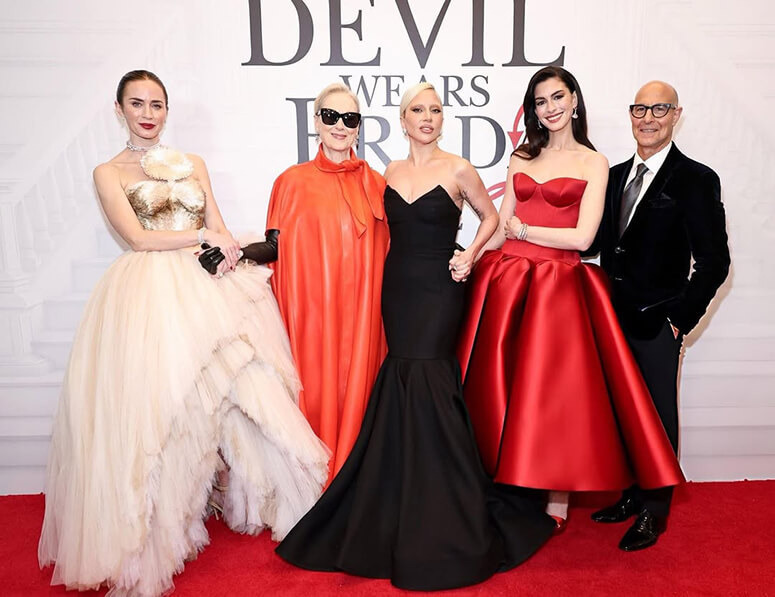
So Andy does what many of her real-world counterparts have done: She pivots. Back to Runway, back to Miranda, back to a system she once escaped—only now with clearer eyes and a more practical goal. She is no longer chasing dreams. She is negotiating stability. It’s a subtle but telling evolution, and for those who have lived through the last two decades in media, it hits a little too close to the bone.
Across from her stands Meryl Streep’s Miranda Priestly, still composed, still commanding, but now operating in a world where authority must occasionally justify itself in terms of revenue. Miranda, once the final word on everything, now finds herself gently—but repeatedly—reminded of what she can’t say in a more carefully worded 2026. The film is clever enough not to dismantle Miranda, but to reposition her. She remains formidable, but the ecosystem has shifted. Power no longer resides solely in editorial judgment; it now flows through ownership, data, and advertising spend. There is a quietly devastating moment when she tells Andy, “You will fail.” Once a test, now it lands like an industry forecast.
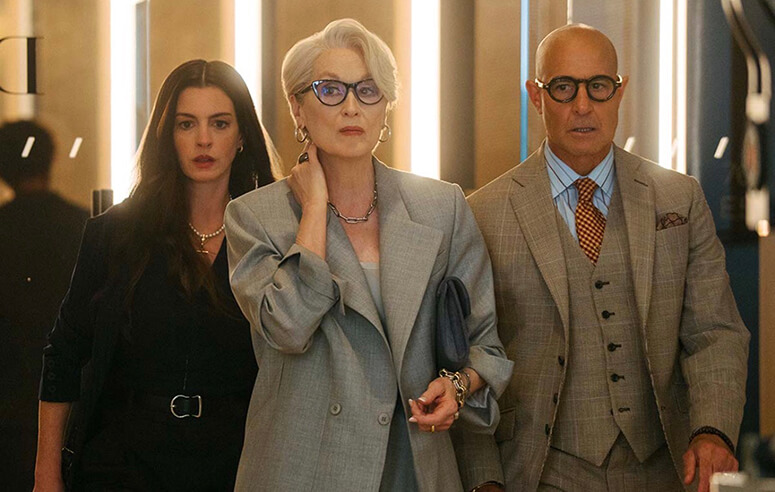
reunite in a Runway world that looks the same — but plays by very different rules. 20th Century Studios
CONTINUE READING BELOW

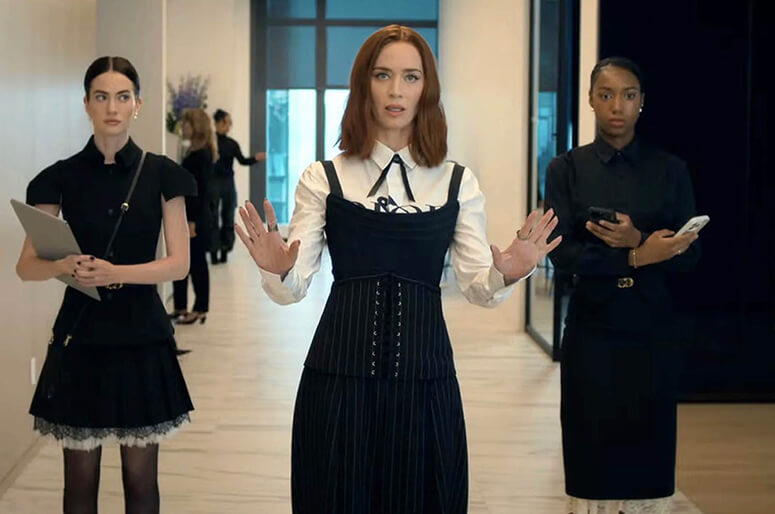
Emily Charlton, played with razor precision by Emily Blunt, may well be the film’s most satisfying evolution. No longer the overworked assistant, she is now installed at Dior, holding the purse strings—or at least controlling access to them. Emily hasn’t mellowed; she’s matured into exactly the kind of power player the modern industry rewards: strategic, connected, and just intimidating enough to get things done. Her scenes with Miranda are layered with subtext, particularly in moments where editorial prestige meets advertising reality. For anyone who has worked in publishing, this is the stuff of knowing glances and tight smiles. The IYKYK factor is strong.
Then there’s Nigel, ever elegant, ever perceptive, brought back with warmth and quiet gravitas by Stanley Tucci. If he once represented the romance of fashion, here he represents its endurance. He understands the compromises because he has survived them. There’s less illusion, more acceptance—and perhaps that’s the most realistic character arc of all.
‘The Devil Wears Prada 2’ serves couture and cameos — then slips in a sharper story about layoffs, pivots, and platform power.
Hovering above—and, more accurately, owning—much of this new world is the tech titan played by Justin Theroux, whose resemblance to Jeff Bezos is so pointed it practically winks. The portrayal leans into caricature—just enough to amuse, and just enough to sting. The film has fun with this, offering a subtle but satisfying roast of the disruptor archetype: the man who doesn’t edit content, he acquires the platform that distributes it. It’s here that one of the film’s sharpest insights emerges: Power has migrated. The gatekeepers didn’t disappear; they were simply replaced.
And perhaps the most telling moment comes not with a flourish, but with a line. Miranda gives Andy the permission to write her biography— nay, exposé—suggesting it might “buy (Miranda) another year or two.” It’s delivered with characteristic restraint, but the implication is seismic. Legacy is no longer assumed; it must be managed. Even icons are now on borrowed time.
The film is rich with fan service, but it wears it lightly. The cerulean sweater gets its knowing nod—less a callback than a cultural handshake. The cameos arrive like a curated guest list: Lady Gaga, Donatella Versace, Marc Jacobs, Tina Brown, Jenna Bush Hager, Law Roach—each appearance landing somewhere between delightful and deeply meta. This isn’t just stunt casting; it’s a reminder of how intertwined fashion and media remain, even as both evolve.
And then there’s the machine surrounding the film itself. The global media blitz ahead of its premiere—interviews, fashion week tie-ins, product placements, viral moments—felt like an extension of the narrative. Hathaway, Streep, Blunt and Tucci circled the globe in a campaign that mirrored the very ecosystem the film critiques: glossy, omnipresent, optimized for engagement. The marketing wasn’t just promotion, it was proof of concept.
What made the pre-premiere circus even more delicious was how thoroughly Anna Wintour leaned into the mythology she once kept at arm’s length. There she was, sharing a Vogue cover with Streep—editor and avatar, side by side, as if the roman à clef had finally come full circle. It was a master class in narrative control: Embrace the caricature, and you own it. All of which makes Wintour’s oft-stated inability to recall Lauren Weisberger rather rich, considering the assistant went on to write the book that built the myth.
Are there quotable lines? Yes. Are they destined to become cultural shorthand the way the original’s were? That’s less certain. Not because they lack wit, but because they now exist in a landscape that consumes and discards language at speed. A great line today has to compete with an entire internet.
But The Devil Wears Prada 2 isn’t chasing immortality. It’s doing something more interesting: documenting a shift. From aspiration to adaptation. From authority to negotiation.
For those who were once Andy’s age—who believed in mastheads, in bylines, in the quiet power of print—this film feels less like a sequel and more like a mirror.
Stylish, yes. Funny, certainly. But also uncomfortably accurate.
Because the real devil no longer wears Prada.
He signs the checks.
***
The Devil Wears Prada 2 is now screening in theaters.

WATCH: Pixar Summer Fest adventure at Hong Kong Disneyland
August 10, 2026
WATCH: Is OPM still as good as it used to be? (Generations Ep. 20)
September 9, 2026
WATCH: Discovering Vietnam in three days
June 9, 2026