Two artists paint through their points of origin
Emerging from Central Luzon’s forested land where nomads once roamed, the province of Tarlac features a unique mix of marshlands in the north and east and tall mountains to the west. These distinct regions allowed it to support a thriving culture of migratory Aetas as well as act as an administrative district for Spanish military operations during the colonial period.
The landscape of Tarlac, now an agricultural hub bristling with sugar mills and vast solar installations that resemble an Area 51 outgrowth, brings to mind the alterable, shifting nature of Filipino identity itself—a place of intersection, a point of origin. It is where history and forward-thinking intersect, where routes of arrival and departure coincide.
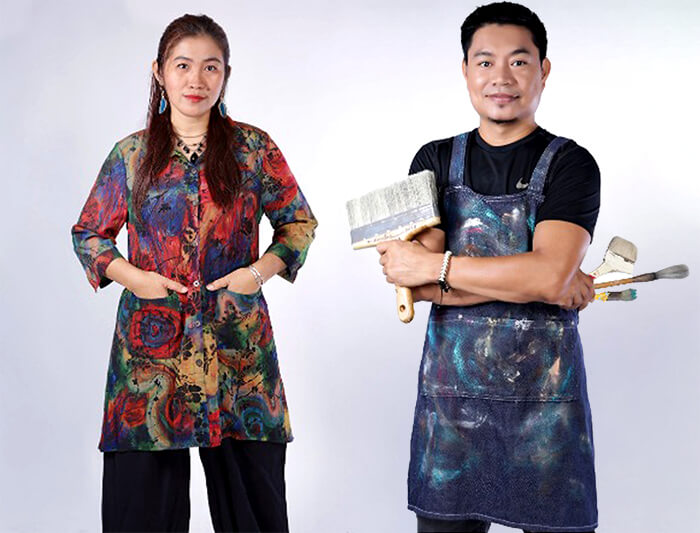
“Point of Origin,” the latest exhibition at Diwa ng Tarlac by visual artists Ayen Quias and Noel Nicolas, is a celebration of the landscape of Tarlac while also a showcase of the excursions and navigations the pair has witnessed over the years as they have made their way across the world and back again. The couple, renowned as artistic partners in their craft, confront the idea of a place as a starting point to explore questions of homecoming, the interplay of the exterior and interior, and finding a kind of momentary stillness in motion.
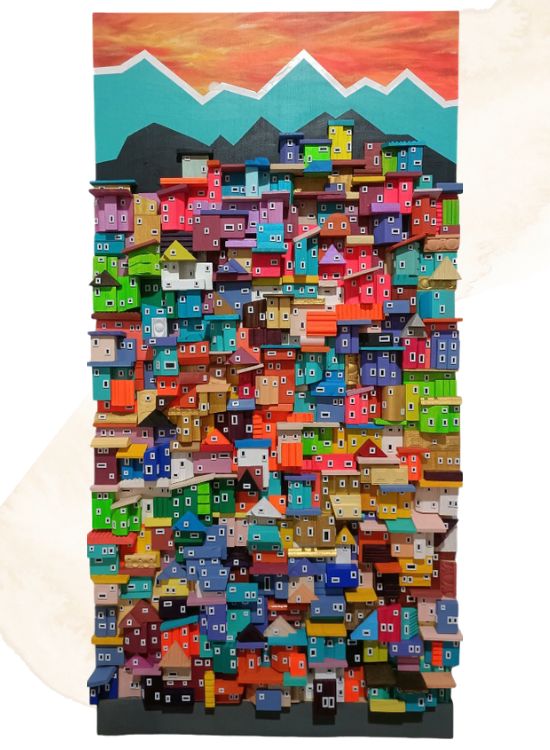
Quias’s signature style—stacked, multi-colored installations of the various places she’s visited—began as chilly landscapes of Baguio. An architecture graduate from the University of Cordilleras, Quias’s experiences eventually broadened, with a trip across Europe becoming a hinge that expanded her understanding of art could be: “My relationship with Europe, specifically Italy, was a turning point,” she said in an interview. “It didn’t change what I do, but it deepened why I do it. Italy opened a door by showing me that my fascination with vertical, colorful communities is a global connection.”
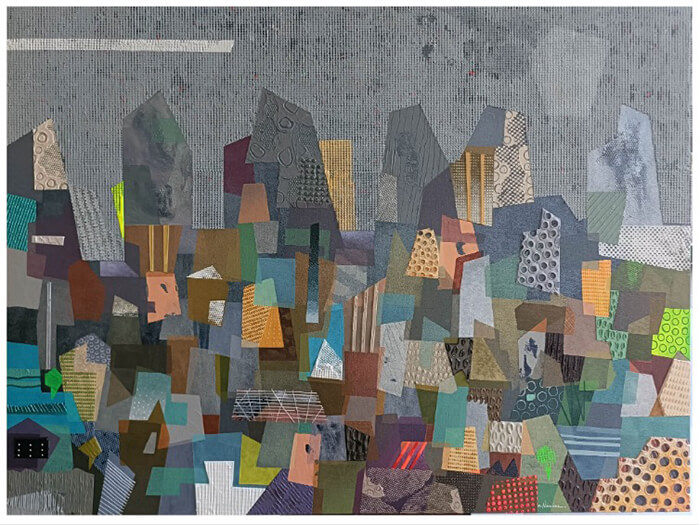
Place—seeing how it could alter the spirit of its inhabitants and unlock broader creative horizons—was also a lifeline for Noel Nicolas who grew up surrounded by the mountainous landscapes of Tarlac: “Lumaki ako na nasasaksihan ang payak naming pamumuhay at ang kagandahan ng kalikasan sa paligid—mga bukirin, bundok, at malalawak na tanawin. Doon nagsimula ang aking inspirasyon sa sining, lalo na sa pagpipinta ng mga landscape na sumasalamin sa aking pinagmulan.”
In their art practice, both Quias and Nicolas depict exterior frames and physical structures —stacks, doors, buildings—filtered through a sensibility that sees city life as bustling, full of potential. Though Quias’s “Little Town” series features no doors, it’s clear that these works did open a lot of doors for her as she’s grown in stature in the local Tarlac art scene. “During the pandemic, I transitioned to wood collage using scrap wood from my family’s craft business. This led to my ‘Little Town,’ stacked houses with no doors, only ‘windows of hope,’ representing our shared isolation and a desire for closeness.”
Reflecting on the significance of the exhibition, Quias notes: “Our collaboration for this exhibition was born from a shared realization during our time in Europe. We found our individual journeys mirrored one another. We were both moving through the Old World, absorbing its deep history and landscapes, while also feeling the pull of our roots back home.” The “Point of Origin” exhibition (running until March 27) is a culmination of the ethos of Ayen’s “Little Town.”
Bringing together cityscape paintings of Nicolas alongside Quias’s stacked houses, the exhibition blends their distinctly architectural approach to art with a quirky, bright embrace of the communities that nurtured their art practice. Across the contributions of both Quias and Nicolas to “Point of Origin,” childlike wonder remains at the forefront of each artwork’s atmosphere.