

An archive in the middle of things
What is it that sets an archive apart from memory? Is it merely the tangibility of it? A concrete organization of things in recorded time? Or is it more so the imperfection of memory in contrast—its fleeting, vulnerable approach to time that allows its subjects to exist in fragments, in between, in positives and negatives, and in lights and darks?
Galleria Duemila’s “Negative Capability” is an homage to 50 years of the gallery’s institutional history and direction under Silvana Ancelotti-Diaz. Curated by Angel Velasco Shaw, the exhibition weaves through institutional archive and memory to tease out moments of vulnerability, of human connection through time, and what it means “to create despite.”
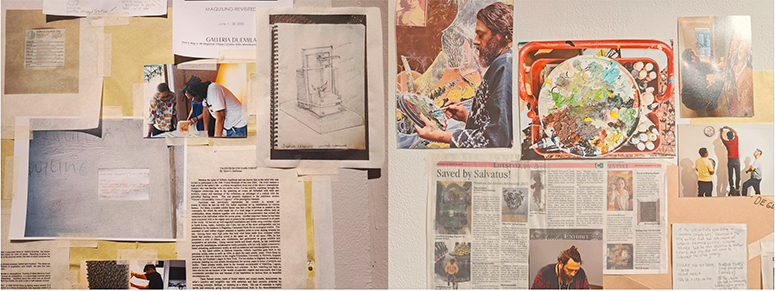
At first sight, the sense of the archival is already salient, deliberately disrupting the white walls of the gallery space. Interspersed between the works of Alfredo and Isabel Aquilizan, Charlie Co, Manny Montelibano, Kawayan de Guia, and Nona Garcia are press clippings, documents, photographs, exhibition concepts, maps, sketches and pamphlets plastered on the walls like annotations to the process behind the works of each artist, as well as their respective histories of working with the gallery. The exhibition space becomes a curation in medias res, and the archive is rendered as fragments of memory in motion as we bear witness to the process, the interactions—the people that have made all of this possible.
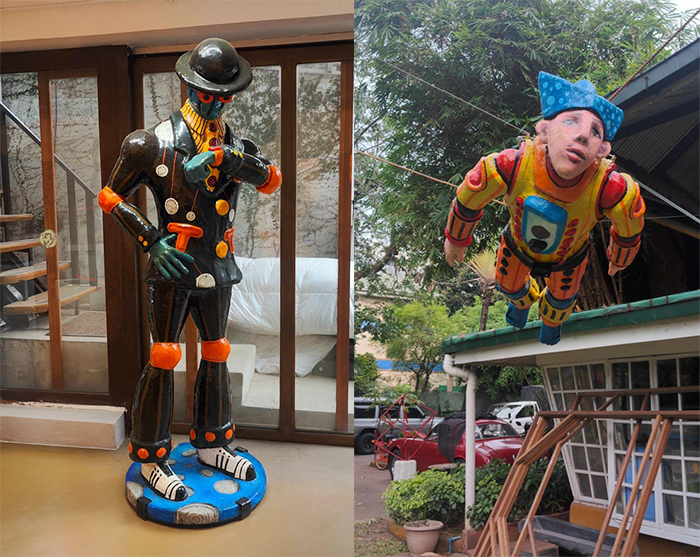
Opening with a work from Charlie Co, “Man’s Time” is a surreal figure crafted in fiberglass resin and rendered in stark blacks and oranges familiarly characteristic of Co’s paintings. With limbs and features like a futuristic automaton, the standing figure, clad in a pinstripe suit adorned with motifs of a swirling clock, poses mundanely as if to check the time on his wristwatch. Meanwhile, in the garden outside the main exhibition space, two similarly futuristic figures entitled “Soaring High,” posed as if mid-flight, bid the viewer—one in welcome and one in farewell. There is a playful caricature of lightness and sentimentality here, a sense of joie de vivre in the passing of time that finds its charming contrast in Co’s painting “Faces of the Heart,” the rugged impasto of an open heart, here dissected to reveal its carnivalesque anguish.
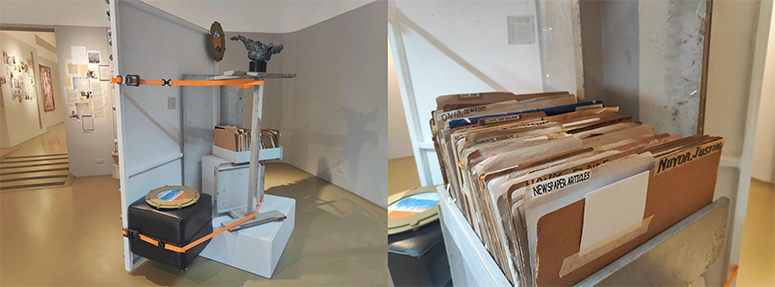
Alfredo and Isabel Aquilizan’s “TIME/LINE 1” and “TIME/LINE 2” are assemblages constructed from old works in the gallery’s collection, a video work by Kawayan de Guia, furnishings found on-site (an office desk designed by Ancelotti-Diaz in 1975 and a black leatherette cushion), and Galleria Duemila’s archive folders. Through an assemblage of the archival and material, the Aquilizans re-construct a timeline not as linear, but as a makeshift architecture of memory. In “TIME/LINE 2,” annotations to the work document an older jeepney assemblage project by the Aquilizans entitled “IN GOD WE TRUST,” supported by Ancelotti-Diaz and shown at the 50th Venice Biennale in 2003. “TIME/LINE 2” plays footage from the production of “IN GOD WE TRUST” recorded by Kawayan de Guia, coincidentally drawing intersections with the latter’s practice of artistic assemblage and working with material culture. Together, “TIME/LINE 1” and “2” become a testament to the artists’ relationship with the gallery, a sort of scrapbook assemblage that celebrates risk, spontaneity and imagination that creates possibilities from encounters between different people, spaces and times.
We see similarly an engagement with materials of the everyday in a series of 50 paintings by Nona Garcia entitled “Picking Up the Pieces (Series II).” A thread of sentimentality runs throughout Garcia’s paintings, tying together the objects that she depicts: a collection of small objects gifted by the late Katrin de Guia to the artist. Rendered in a hyperrealist style, the mundane reality of these cherished objects, set against the cold and stark surface of cement evokes introspection on impermanence and the passing of time. While there is a spirit of the archive in Garcia’s act of recording temporality in paint, she dissolves all rigid sense of the archive into the realm of memory, here turning objects into sentimental artifacts of the everyday.
CONTINUE READING BELOW

Manny Montelibano expands on this thread of sentimentality in the everyday through a video work entitled “Contemplari: Revisiting Escabeche.” The work projects short clips of telephone conversations on the floor of the exhibition space, the moving mouths of the speakers are the only visual fragments visible from the clips we see. The piece recomposes audio recordings from his first exhibition at Galleria Duemila in 2009, entitled “Escabeche: Sweet and Sour,” an interactive installation that allows visitors to listen to said conversations via telephones that hang from the ceiling of the gallery space. By revisiting a work that grapples with the diasporic experience of time and distance, Montelibano recomposes fragments of the everyday into a montage of things said in passing, a collection of audio ephemera that calls back to a memory of something once heard but now rendered ever-distorted in recollection.
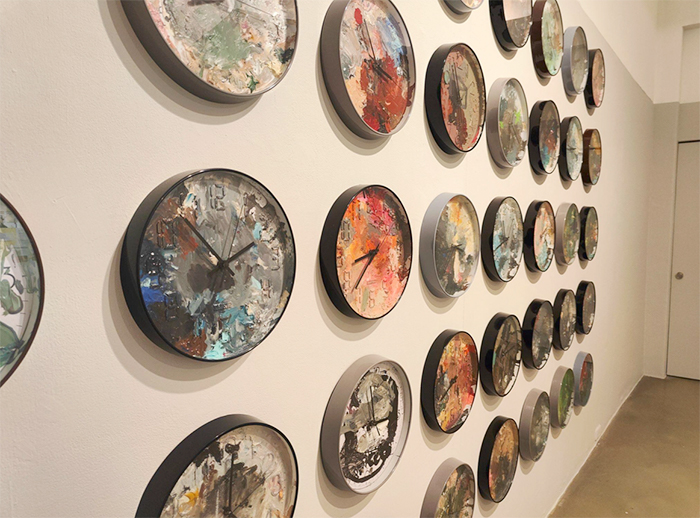
Kawayan de Guia’s work traces back to plural conceptions of time as seen in Aquilizan’s reconstruction of “timelines” while also drawing parallels with Nona Garcia’s work through a series of 50 palette clocks entitled “Painting Time / Time Painting (Series II).” Much like Garcia’s work, the series draws from an accumulation of everyday materials, this time through de Guia’s clocks, which he had actually used as palettes while working on a series of paintings for a concurrent exhibition in New York. What appear as somber and earthy abstractions on these clocks become a set of gestures conducted to the mundane march of time, becoming, as in Montelibano’s work, a montage of things in passing, albeit rendered in a blur of moments in color.
Finally, de Guia’s mixed-media painting “Kislap ng Gayuma” is rendered as a vintage movie poster collaged with postage stamps and bone marrow. Set across the series “Painting Time / Time Painting,” the work seems to refer back to the archival materiality that threads throughout the exhibition: one that ruptures the idea of time as something that must be linear, perfect, and static.
Here, the archive is set into motion by memory through fragmentary artifacts of the everyday, of sketches behind the scenes of the exhibition, and the mundane encounters that make all of this possible. “Negative Capability,” at its bravest, does not attempt to freeze a moving target into place, but instead lets its vulnerability unfold in the middle of things.
* * *
“Negative Capability” runs until June 20. Galleria Duemila is open Tuesday through Saturday from 10 a.m. to 5 p.m.

WATCH: Is OPM still as good as it used to be? (Generations Ep. 20)
September 9, 2026
WATCH: Save for retirement or enjoy life now? (Generations Ep. 21)
September 16, 2026