Celebrating a half-century of Galleria Duemila
I had this question to ask Italian-born Silvana Ancellotti-Diaz, who runs, and has run, Galleria Duemila for 50 years in her adopted home of the Philippines. It was this: “Let’s assume that I’m an alien from another planet. How would you describe the evolution of Filipino art over the last 50 years?”
Turns out I didn’t need to ask the question. Silvana and her longtime friend and curator Angel Velasco Shaw had plenty to say about the retrospective show “Avanti Sempre Avanti (Forward, Ever Forward),” running until March 28 at the Loring Street, Manila Gallery.
The press preview came before the night’s gala, which featured artist-friends from her lifetime spent presenting the best of Philippine talent and expression. The walls are hung with heavy hitters: Pacita Abad, “Lee” Aguinaldo II and Federico Aguilar Alcuaz, BenCab, Ed Castrillo, Roberto Chabet and Charlie Co; from “Malang” Santos, Isabel Diaz, Impy Pilapil, Cesar Legaspi, Jose Joya, Arturo Luz to H.R. Ocampo, Juvenal Sanso, R.M. De Leon. Many have passed, but their work on the walls reminds us of their place in the evolution of Philippine art.
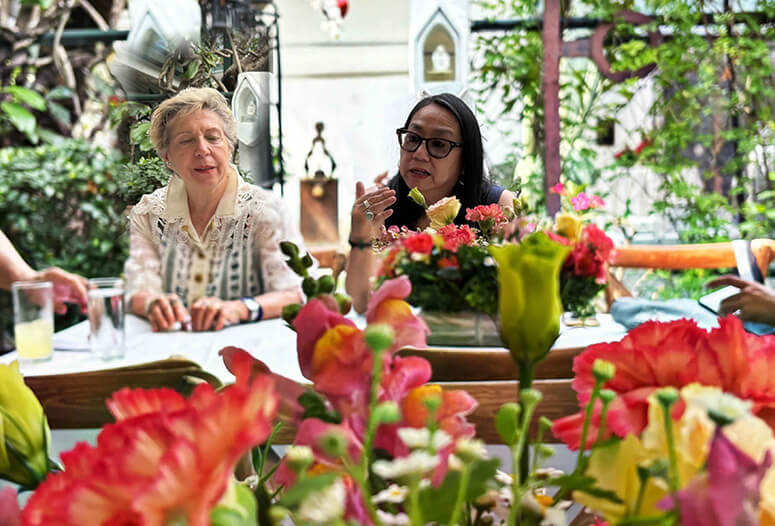
Curator Shaw insists it’s not an “evolution,” and I get it: so much waxing and waning amid individual perspectives in art, so much borrowed magpie energy and interchange, reimagining the nest with every build. It’s Silvana’s gift to have an eye for these brilliant art energies. (She and Shaw hint at the massive archival project, “hundreds of boxes,” eyeing a permanent nest at the National Museum of Arts Manila. Stay tuned.)
Silvana came to the Philippines from her native Mantova, Italy at 22, marrying Filipino artist Ramon Diaz. She also fell in love with the local art scene, in a post-war environment that began to thrive under Purita Kalaw-Ledesma, founder of the Art Association of the Philippines, and Lydia Villanueva-Arguilla, founder of Philippine Art Gallery. She began buying up antiques and modern art, eventually pooling money from friend Christina Pagaspas Hagedorn and P20,000 borrowed from her businessman father-in-law (“I remember he told me, ‘This is the worst investment I’ve ever made in my life’”) to open Galleria Duemila 2000—which is what “duemila” means. She befriended the Saturday Group, which included BenCab, Castrillo, Joya, Legaspi, Luz, Ocampo, Romulo Olazo, Onib Olmedo, Sansó and others, and touched upon every art fluctuation that has crossed her radar ever since. Duemila remains the oldest Filipino art gallery.
The title of this show speaks of Silvana’s background, and also ours. Avanti Sempre Avanti: “That was the motto of my father, when he was in a concentration camp during WW2,” she tells us. “There is strength in surviving. You fall, you cry, you stumble. You stand up again.” Also the idea of “perseverance, the belief in a better future—that humans must not look aside from what is happening because it will remove your strength.” The motto applies also to Filipino artists, as well as those who grapple with what art is telling us: the critics, the public.
“Silvana is a very strong advocate of the relationship between art, culture and education,” says Shaw, who grew up in New York but has devoted her time and life to Filipino art, much like Silvana. (A Duemila book is due later this year.) “For Silvana, as an Italian, art was everywhere. She grew up in it. In our nation, it’s not quite like that. You know, people have accused the Philippines of being too Western—where’s your culture? Where’s your Angkor Wat? But if you understand the history of this country and how it evolved, it’s understandable why those kinds of artifacts are not here.” Indeed, Silvana watched local priests tossing out Spanish-Filipino religious artifacts from churches, preferring the “modern” to the antique.
Instead, a new narrative and story had to emerge from the ground up, and Silvana’s gallery was there to take a running pulse. “There is a responsibility of being Filipino, just like being Italian,” she says. “You have to preserve the beauty—it’s like when you preserve something that your mother had, right?”
During the media launch, son Illac Diaz, founder of Liter of Light, is helping to arrange the lights (naturally) for tonight’s gala launch. Her daughter Romina writes on Instagram about her mother’s preservation instinct: “She rose each morning with the certainty that art could save us, and because she believed, so did others.” The artists infused their lives, “arriving with paint on their fingers, on their clothes, sometimes on their very souls… They would sit at our table, arguing, laughing, imagining futures no one else could yet see.”
“I was embedded with this idea of helping each other: Noblesse oblige,” Silvana tells us.
“No matter what gift you have, you must share it.”
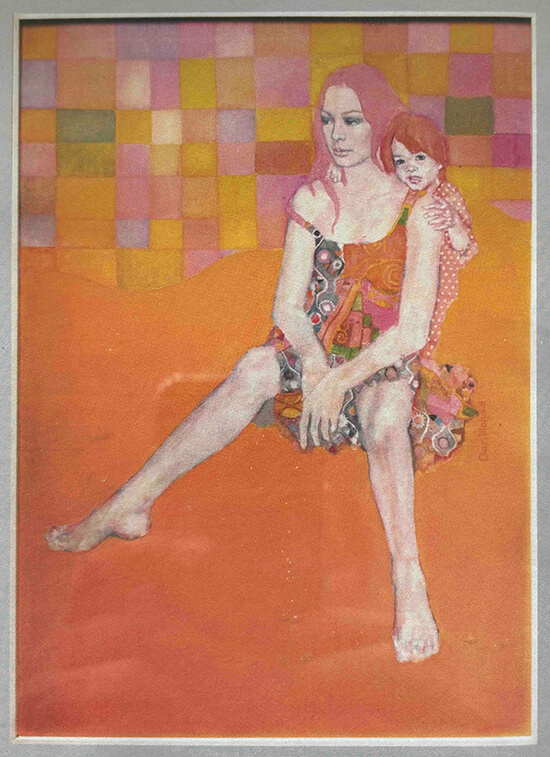
Her walkthrough of the 47 curated works begins in the 1950s with Malang pieces; a rare BenCab still life, instead of his trademark muse Sabel; a bold silver Arturo Luz; a bright orange Isabel Diaz painting of her mother, Miss Universe Gloria Diaz from 1969 (“Anxiety of Motherhood”) sharing space with Julie Lluch-Delana’s 1994 “Cactus,” a barbed phallic sculpture contemplating love and marriage.
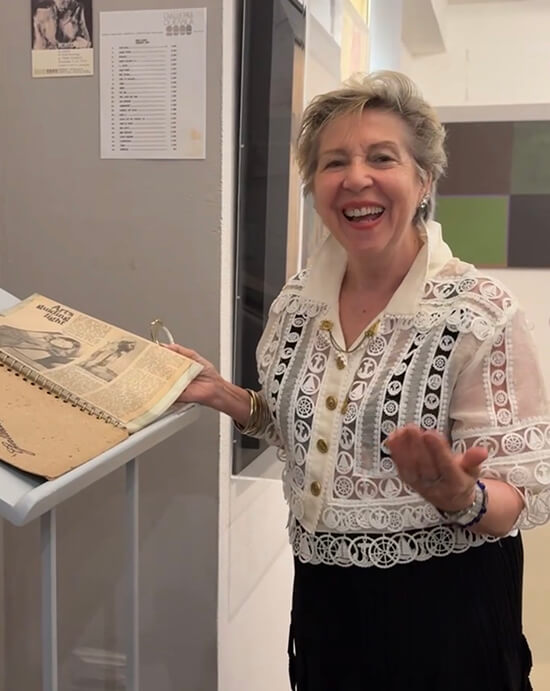
She laughs at her displayed scrapbooks, handmade collections of xeroxed photos and clippings. “A real archivist would say they’re not kept well.” Yet she’s kept all the press stories over the years, the price lists, the invitations.
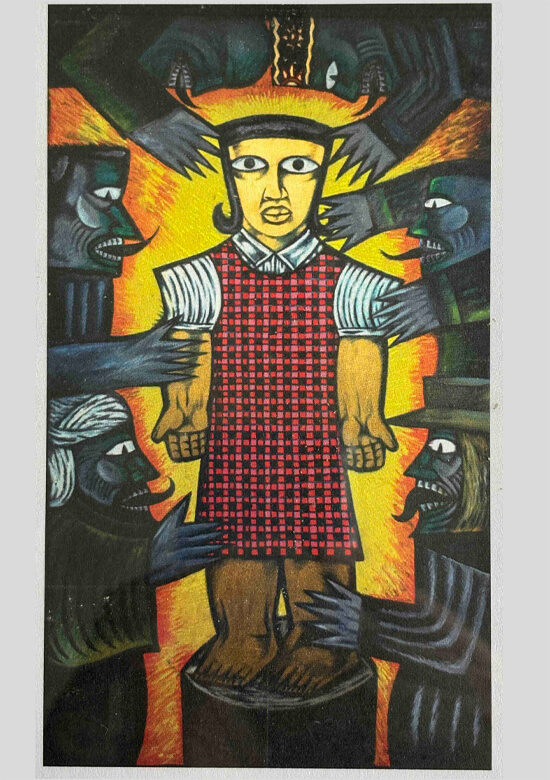
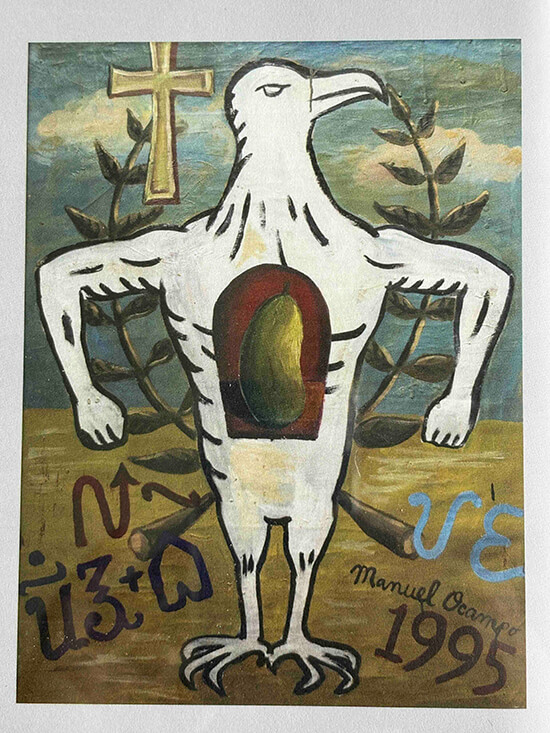
We stop at Nunelucio Alvarado’s “Maid in Negros Goes Global,” an intense work depicting rich men gravitating towards an innocent girl with covetous looks. Silvana says it speaks to her of “the poverty, and the way the rich grab what they can get from the poor.” Not surprisingly, it sits next to an untitled outburst from Manuel Ocampo, who’s “very much involved in history, very much against materialism, the Church.” The Bald Eagle flexing its muscles represents “the strength of America.”
We pause before a piece by longtime friend Pacita Abad. “Rolling Stones,” completed the year of her death from cancer for an upcoming show at CCP, was worked on by Abad while lying in bed, undergoing chemo treatment in 2004. It reflects on the artist’s witnessing refugee migrations in Bangladesh and Thailand.
We are all migrants, to an extent. Silvana, like Shaw, like this writer, have ventured beyond the familiar stories. You take baggage with you, as much as you leave behind. All of it tells a story.
“For me, it’s extremely important that you put together everything—the indigenous, the plants, the weaving,” Silvana says not only of Duemila’s history, but of her ongoing archiving project, her nesting instinct. “This has to be treasured, because it changes, and if you don’t give importance to this, it disappears.”
* * *
“Avanti Sempre Avanti (Forward, Ever Forward)” is at Galleria Duemila, Loring Street, Manila, until March 28.