

Sandbox gives ‘Spring Awakening’ a fresh voice
An uprooted tree with roots exposed and a massive cross hanging from above, together with decaying Brutalist structures below, set the tone for the Sandbox Collective’s Spring Awakening, a musical set in 1890s Germany. But it could very well be present-day Philippines, reflecting a winter of discontent where corruption is eating society at its core and truth is being repressed.
It’s particularly detrimental for the youth when the political elite, religious institutions and educational systems censor information and command blind obedience. In the first scene, Wendla Bergmann (played with an innocent, charming naiveté by Sheena Belarmino) pleads for her mother (Menchu Lauchengco-Yulo alternating with Ana Abad Santos, both playing all the adult female roles, effectively distinguishing the characters from one another) to teach her how children are made, to the parents’ consternation. Forced to give an answer, Frau Bergmann tells her that “you just have to love your husband,” leaving the poor child still in the dark about her body.
The mission is to stage challenges the youth still face and truly resonate with the times: sex education, mental health, suicide and gender identity.
Ridiculous as it may seem, sex education is still not as widespread as one would imagine. The RH law, providing access to contraceptives and sex education, after 14 years of debate with strong opposition from the Catholic Church and conservative groups, was only passed in 2012 and has only been partially implemented to this day, when teen pregnancy is still considered a national emergency.
Aside from the lack of comprehensive sex education, mental health, suicide, and gender identity are some of the other challenges that the youth still face and are tackled in the musical, according to Sandbox’s managing artistic director Sab Jose Gregorio, who has taken on the organization’s mission “to stage works that truly resonate with the times.”
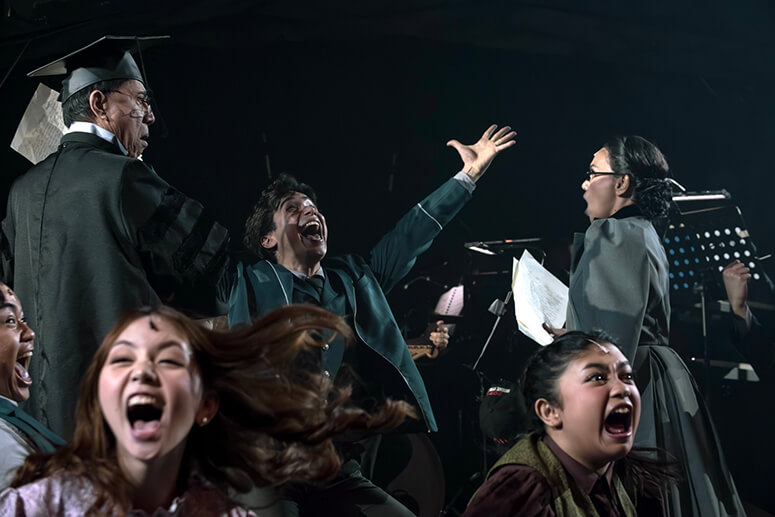
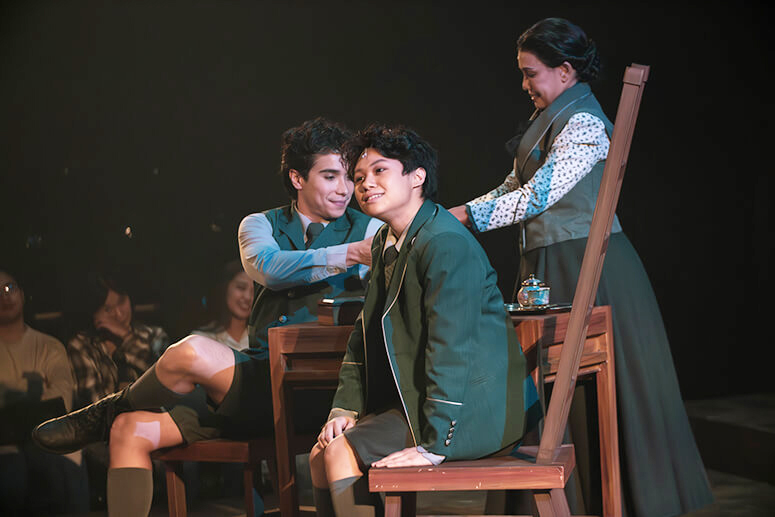
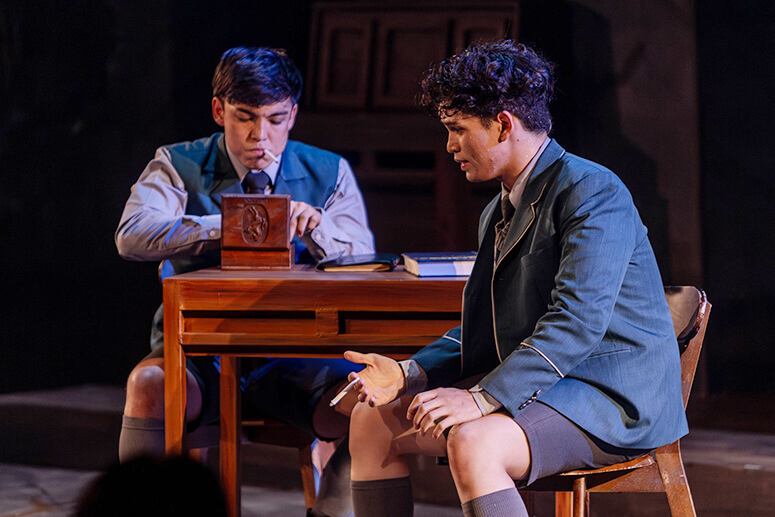
What is just as dangerous is when students are taught to learn by rote and accept whatever the teacher says without learning to think on their own. This doesn’t hold water with the rebellious Melchior Gabor (Alex Diaz alternating with Nacho Tambunting, both excellent, with the former displaying more of the character’s aggressiveness and arrogance and the latter highlighting his intellectual confidence ) who questions his teacher, Herr Sonenstitch (Audie Gemora playing all the adult male roles with nuanced, distinct characterizations), for harshly chastising his friend, the nervous and anxious Moritz Stiefel (Omar Uddin alternating with Nic Chien), prompting the elder to hit him with a stick.
CONTINUE READING BELOW

It turns out that Moritz is doing poorly in class because of anxiety over wet dreams, which Melchior explains to him as the other boys share their own frustrations with their sexual thoughts and desires, which are not helped any with the lack of guidance from either the parents or the school.
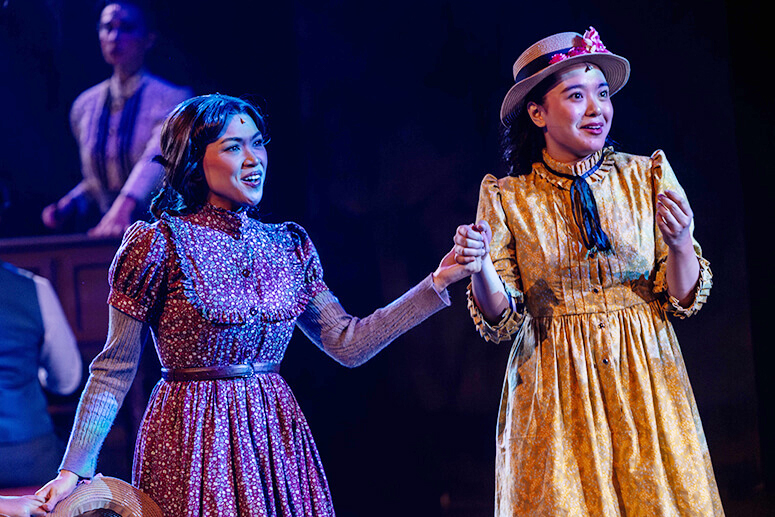
The girls—while pining over their crushes and desires for intimacy—also have their own frustrations, including a grave one from Martha (Angia Laurel) who reveals that her father is abusing her sexually while her mother turns a blind eye. Laurel, in her theater debut, renders the haunting The Dark I Know Well with a deep, rich timbre that conveys all the hurt and helplessness called for in this iconic number. She begs her friends not to tell anyone for fear of reprisal, citing the case of the similarly abused Ilsa Neumann (Jam Binay) who had to leave the house and wander homeless.
Remaining silent, together with societal pressures and unreasonable expectations, further adds to the angst of these adolescents. When Melchior and Wendla fall in love, they cannot do so without guilt hanging over their heads, and when Moritz fails in school, he cannot get any compassion from his father who is only worried about what other people will say, leading him to despair and to entertain thoughts of suicide. We didn’t get to see Nic Chien, but Moritz has some of the most intense scenes dramatically and musically, which Omar nails perfectly, particularly the heartbreaking Don’t Do Sadness.
These themes all come to light through clear storytelling, a seamless fusion of drama, music, and visual design that director Andrei Pamintuan achieves with a vision that his creative team helps realize.
Wika Nadera’s dynamic set design positions the band right on the stage with the action transpiring in front, on the sides and above it. To further make the audience feel part of the drama taking place, actors are positioned within them or at the edges of the stage when they’re not on it.
Raven Ong’s costumes pick up from the dark symbolism of the sets through a muted palette. While staying true to the period, they look lived-in and harmonize with the overall design.
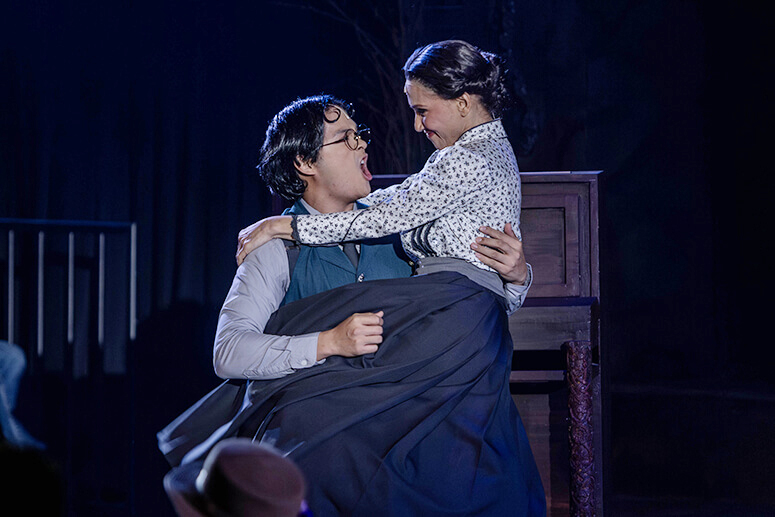
The dark underworld of oppressed teens is further enhanced by D Cortezano’s precisely conceived lighting design that is atmospheric and emotional.
Cortezano’s “color dramaturgy” works together with the colors of the musical score (Duncan Sheik with lyrics by Steven Sater), which has some of the most beautiful songs mixing alternative rock, folk, and pop with some melodic, haunting harmonies.
Musical director Ejay Yatco perfectly blends raw rock rhythms with nuanced, intimate vocal performances while highlighting the story’s emotional undertones. Under his direction, the band earns its place on the stage, a virtual character that supports the ensemble and brings the story forward.
The sound was quite phenomenal. Aron Roca’s sound design was balanced with instrumentation and voices articulated clearly despite being the inaugural presentation at the Black Box of the Proscenium Theater.
Another factor that gave this production an edge was the choreography of Nunoy Van Den Burgh, whose vocabulary of sharp, angular movements was so refreshing to see in lieu of the standard fare for musicals.
Together with the music, the movement is something the ensemble naturally adopts to really own their roles. No doubt the verisimilitude is achieved also because they strongly identify with the characters and themes, as does the audience, who can see how Spring Awakening mirrors modern struggles, making it still so profoundly relevant today.
* * *
Spring Awakening runs until March 22 at The Black Box at the Proscenium Theater, Rockwell.

WATCH: Is Gen Z too soft? (Generations Ep. 23)
September 30, 2026