Taiwan's lantern festival this year is unlike any other
After the Lunar New Year celebrations on Feb. 16 and 17, the next red letter day was the Lantern Festival on the 15th day of the first lunar month, which was March 3 this year. There was a total lunar eclipse that night, resulting in a blood moon; seen from Earth with the naked eye (unlike viewing a solar eclipse, no eye protection is needed here), the moon took on a rosy hue as the Earth stood between the sun and the moon. Some saw it as a good sign, while others said it was an ill omen, proof of the latter being the US-Israel attack on Iran and the subsequent turmoil in the Middle East.
The Lantern Festival is a big deal in many communities, but today’s Lantern Festival is a far cry from its origins, believed to go back over 2,000 years to the Western Han Dynasty. The emperor, a Buddhist, saw monks light lanterns in the temple on the 15th day of the first month and ordered that lanterns be lit similarly in the imperial palace, temples, and households across his realm. The practice was also seen as a celebration of the declining darkness of winter, since the Lunar New Year is celebrated as the Spring Festival (chun jie).
Likewise, the day is marked as the birthday of the Taoist deity Tianguan, the god of good fortune, so townsfolk light lanterns as well as hold parades and other forms of festivity to get on his good side so he would grant good fortune. As kids, we were told that the 15th day was the end of the new year celebrations and the last chance to receive angpao or red packets of money that elders give to kids. It was also the time to eat tangyuan, each bowl containing two glutinous rice balls filled with sweetened crushed peanuts, red bean paste, or sesame paste.
In some places, people set off sky lanterns (paper lanterns with a small flame inside), writing their wishes before sending them aloft. This
practice has been flagged as an environmental hazard, as they could cause fires when they fall to the ground, land in trees, or on roofs. In Taiwan, where setting off sky lanterns is a tourist attraction, this is confined to Pingxi and Shifen counties for one day only (Feb. 28 and March 3, respectively), with a limited number of lanterns launched at set intervals.
The annual Lantern Festival is a big deal in Taiwan, with each city and county holding its own festivities. But the main national festival is held in a different location each year, and this year it’s in Chiayi County, in south-central Taiwan, from March 3 to 15. It’s nothing like the traditional parade of red paper lanterns, as technology has taken over and the lanterns are computer-guided, multi-sensory, sometimes interactive, spectacles.
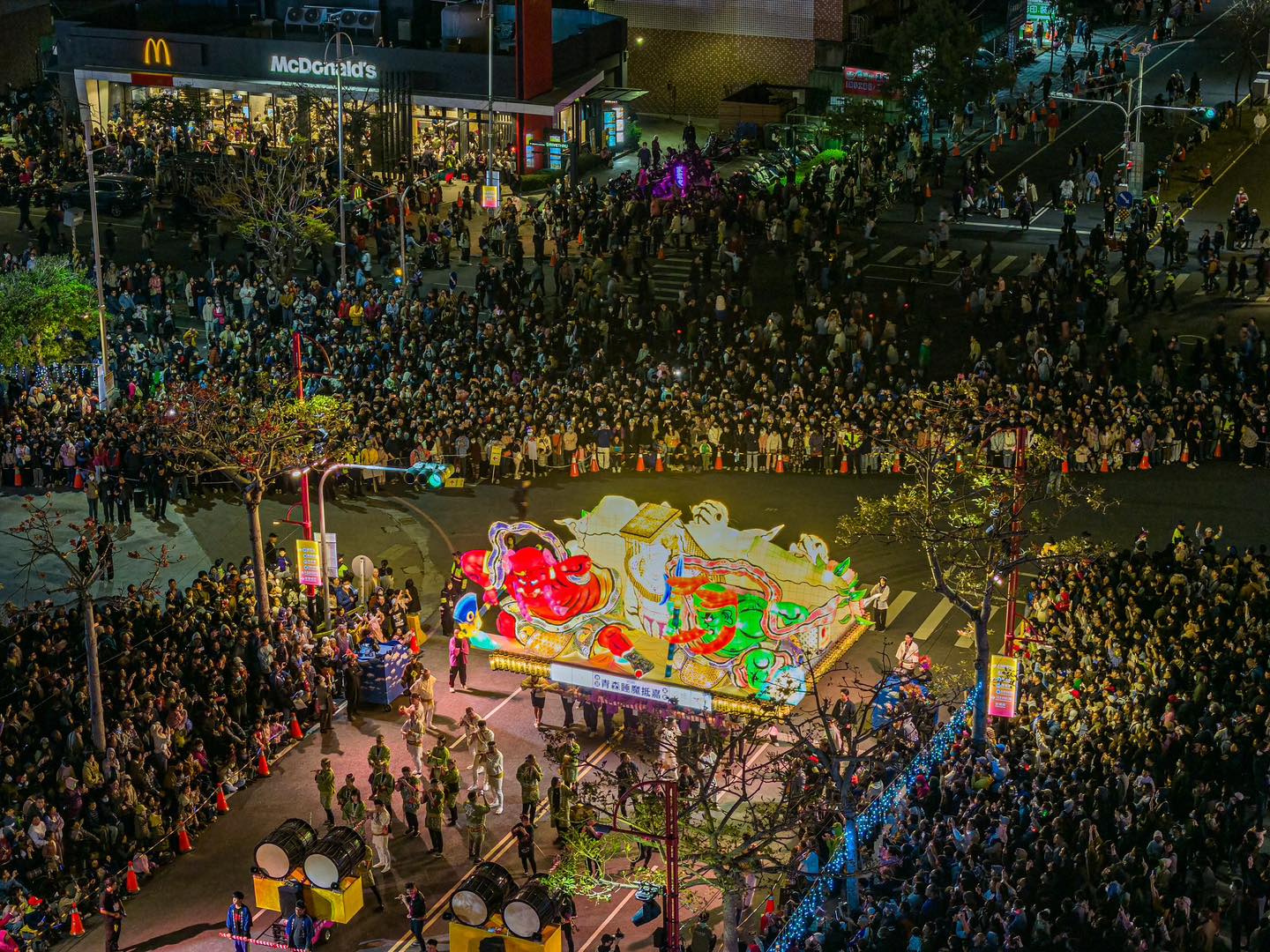
The main lantern, “Radiant Glow—Alishan of the World,” stands. 21 meters tall. It takes inspiration from Alishan—or Ali Mountain—about 75 kilometers from Chiayi, one of Taiwan’s most popular and iconic sites. The lantern’s shape calls to mind Alishan’s sacred tree, a 3,000-year-old giant red cypress that, unfortunately, was struck by lightning and fell in 1998. Emphasizing environmental awareness and sustainability, recycled wood is used in a collage evoking images of the sun, trees, and the mists that envelope the mountain. The light show—held every 30 minutes each evening from 6 p.m. and can be viewed from a special platform—integrates light-and-sound art with digital media to present Taiwan’s natural landscapes in a mesmerizing kaleidoscope.
The festival is spread out over four city blocks, with 22 zones featuring over 600 works—so be ready to walk, walk, and walk some more. Particularly popular with kids is the Super Mario display, a two-hectare area where visitors can interact with the Nintendo mascot. Highlighting Taiwan’s achievements in technology, the Tech World pavilion from last year’s Osaka Expo is set up at the lantern festival. Through immersive
experiences, visitors will get an idea of Taiwan’s technological innovation, industrial excellence, and cultural diversity. The Ministry of Economic Affairs proudly declared Tech World as “the first independently realized world-class pavilion overseas, completed entirely in-house from planning and design to engineering and operations.”
While there is a lot of tech to dazzle visitors, there are more mundane attractions, like a specialty market, a traditional gourmet market, island fun, and a harvest celebration. The main stage will have nightly shows featuring local artists as well as international acts from Ireland, New Zealand, Korea, Hong Kong, France, Japan, and the Philippines. The Pentaflores Dance Company from San Carlos City, Negros Occidental performed during the opening program on March 3.
Certainly, those monks—or even the emperor—who lit lanterns over two millennia ago could not have imagined how their simple act of devotion would become such a full sensory spectacle.