

REVIEW: Everything is a scoop in Chuck Smith's debut essay collection 'Son of a Dead ‘80s Bold Star'
The title of former PhilSTAR L!fe writer Chuck Smith’s debut essay collection Son of a Dead ‘80s Bold Star alone already draws you in with the sensationalized allure of a tabloid headline. One might ask: Is there some truth to it? Or is this parasocial relationship rendered warm and intimate? Might this be about grief and the capricious forces that both undergird and derail one’s understanding of it? Or perhaps a second coming of age?
These assumptions are not completely unfounded, though in the opening essay “Origin Story,” the author tersely sets the record straight: He is not the son of a dead ‘80s bold star; rather, he’s the nephew of a dead ‘80s bold star. And the “bold star”—a term attached to actors in low-budget Filipino movies marked by an excess of erotic content—is who he believed was his biological mother at age seven: Delia Dueñas Smith, popularly known as Pepsi Paloma, the controversial actress who formed part of the ‘80s starlet trio Softdrinks Beauties and died of suicide in her teens, and whose legacy is often trivially tied to two hosts of a noontime show and a comedian or to a song by the Eraserheads.
Such provenance, though built on a misapprehension, makes for a perfect selling point for a book that intertwines popular culture with personal histories, and reveals how “real life operates like a nonsensical soap opera.” “It was not a pretty story, but as far as narratives go, it tied everything together nicely. It was a clean narrative,” Smith writes. “And maybe I even believed it, if only for a bit; an inaccurate story was better than no story at all.”
Issued in paperback by the University of Santo Tomas Publishing House, Son of a Dead ‘80s Bold Star deftly maps both the private and public operations of grief, especially one that is buoyed by a precious lie. The book begins as an investigation of the self—spanning queerhood, mental health, sexual abuse, and notions of family, particularly in the Filipino context—then tacitly shifts into an exploration of Philippine show business, particularly during Smith’s time as an entertainment reporter, and what it means to rub elbows with the industry’s brightest and not-so-bright stars, and even the day-to-day implications of American imperialism (“For a while, my classmates thought I was cool, because I was white with a very American surname,” he recalls). The result quite stunningly diffuses across pseudodiaristic reflections, anecdotes, profiles, and reportage. It reads like part dramedy, part thriller, and part horror. It is compelling and pulses around the idea of writing as memory, healing, and intervention.
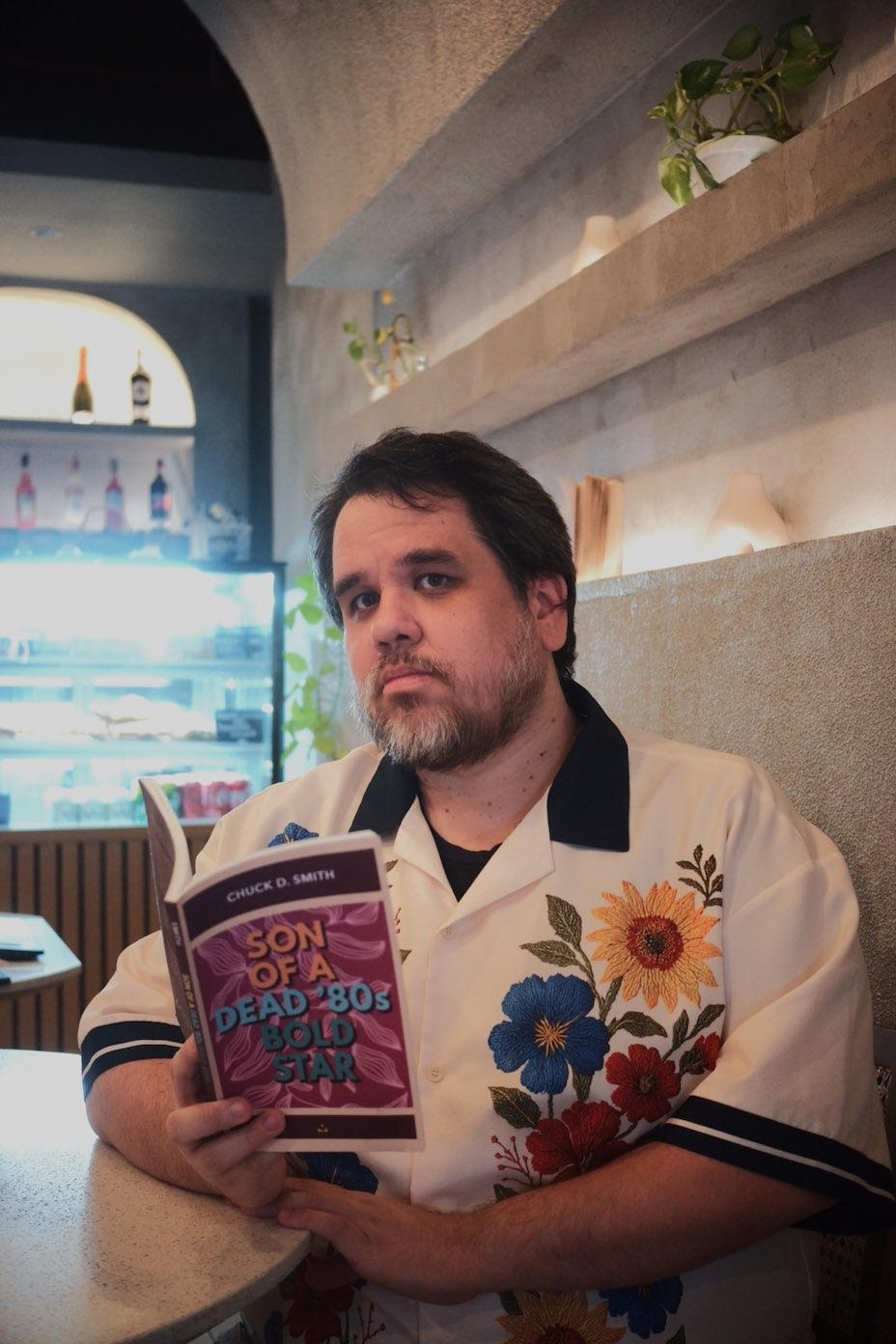
Considering Smith’s background, it doesn’t strike as a surprise that the essayist has a proclivity for intrigue and dramatics. The primary draw of the personal essay, at least to me, is that you often can’t tell which is fact, which is fiction, and which is closer to both. The best essayists possess the dexterity to make their problem your problem. They make the nonsensical make sense. They find logic where there is none. Bonus points if they are funny! Smith not just leans on this sensibility but also has the humor and the fundamental ability to read. Playing to this beat, he can tell a story about a grade school teacher notorious for asking donations for a host of causes or a story about his punishing desire to be a writer and meeting his fierce competition as if it’s celebrity gossip. And who else can turn these mundane anecdotes into seemingly hot showbiz scoops than someone who made a living out of chasing controversies?

What we read, though, is not readily speculation; there’s actual legwork and research involved in it. The book is just over a hundred pages, and the essays are relatively brief and accessible, likely owing to the editorial demands of the publications in which most of them first appeared. Smith’s language is slick and punchy and astounding in its simplicity. His metaphors are effective and not tortured, even as he breaks sentences as if he’s aware that certain parts can be used as pull-quotes. The collection also has some editing errors, shifts points of view, and at times revels in fragmentary structures. These are not necessarily to the book’s detriment, or mean that it’s unruly. Yet, a few entries like “Father’s Day” and “The Weight of Words” read a little too thin and lack the substantial rigor of the rest of the collection.
It is when the author sprawls and meanders that the book finds real shape and is able to fully access the reader’s emotional and intellectual investment, as in the case of the last two essays. In “In The Movies,” for instance, he shrewdly harnesses the power of omission and the inescapable function that serendipity plays in the tradition of spinning great yarns. In “Developing Story,” which opens with the cruel discovery of his lisp, he poignantly highlights a kind of grief that is not necessarily a consequence of death but as something that feels as both a presence and absence, as something that’s always there but never fully acknowledged, residual rather than transitional.
In many respects, Son of a Dead ‘80s Bold Star allows for a fun and fascinating read. It is both a paean to and an evisceration of our country’s Marites culture. It is prose that intimates as much as it intrigues. In Smith’s hands, an erroneous detail results in soulful and insightful contemplations about identity, grief, mythmaking, and the anxious circumstances that surround it. He inquires about that which refuses articulation. He makes a scoop out of the most granular and quotidian, even if that means risking becoming the blind item himself.
Editor's Note: PhilSTAR L!fe was given a free copy of Son of a Dead ‘80s Bold Star. It's now available on Shopee and Lazada.

WATCH: Is OPM still as good as it used to be? (Generations Ep. 20)
September 9, 2026